


Package of 5 Sessions
- Rs.5,999.00/-
The psychology of loneliness goes deeper than being alone. Here's what's actually causing it, what it does to your mental health, and what genuinely helps.
 Dr. Neha Mehta
  23 Jun 2026
  Mental Health
  14 Reads
  8 min Read
You can be surrounded by people and still feel completely alone. Most people who've felt it know this already , and know that saying it out loud sounds strange because from the outside nothing looks wrong.
Full calendar. Active group chats. A job with colleagues. And still this persistent hollow feeling that you're not quite reaching anyone, and no one is quite reaching you.
That's the psychology of loneliness at its most confusing , it isn't about headcount. It's about the quality of connection, the felt sense of being known, and what happens to a person when that's missing for long enough.
Loneliness and mental health are deeply intertwined. Understanding why it happens, what form it's taking, and what actually addresses it , rather than just filling the time around it , is where things start to shift.
The psychology of loneliness begins with a basic evolutionary function. Humans are wired for social connection the same way they're wired for food and shelter , as a survival requirement, not a preference. The emotional pain of loneliness is, neurologically, a warning signal. The brain registering: you are socially isolated and that is dangerous. Fix it.
The problem is the signal fires whether the isolation is literal or perceived. You can be physically surrounded and still trigger it , because the brain isn't counting people, it's assessing the quality of connection. Whether you feel understood, valued, genuinely close to someone. When that's absent , even in the middle of a full life , the alarm still activates.
The deeper psychological reason for loneliness in adults is often a mismatch between the connections available and the connections needed. Work relationships don't fill what intimate friendships do. Acquaintances don't fill what a genuine sense of belonging does. Surface-level interaction doesn't fill what being actually known by someone does.
And for many people , particularly those with emotional isolation in their history, or anxiety and depression that makes connection feel risky , the gap between available and needed grows wider quietly, over years, without being fully named.
According to the US Surgeon General's 2023 advisory, loneliness has reached epidemic levels globally , with measurable health consequences comparable to smoking 15 cigarettes a day. The psychology of loneliness isn't a soft concern. It's a public health one.
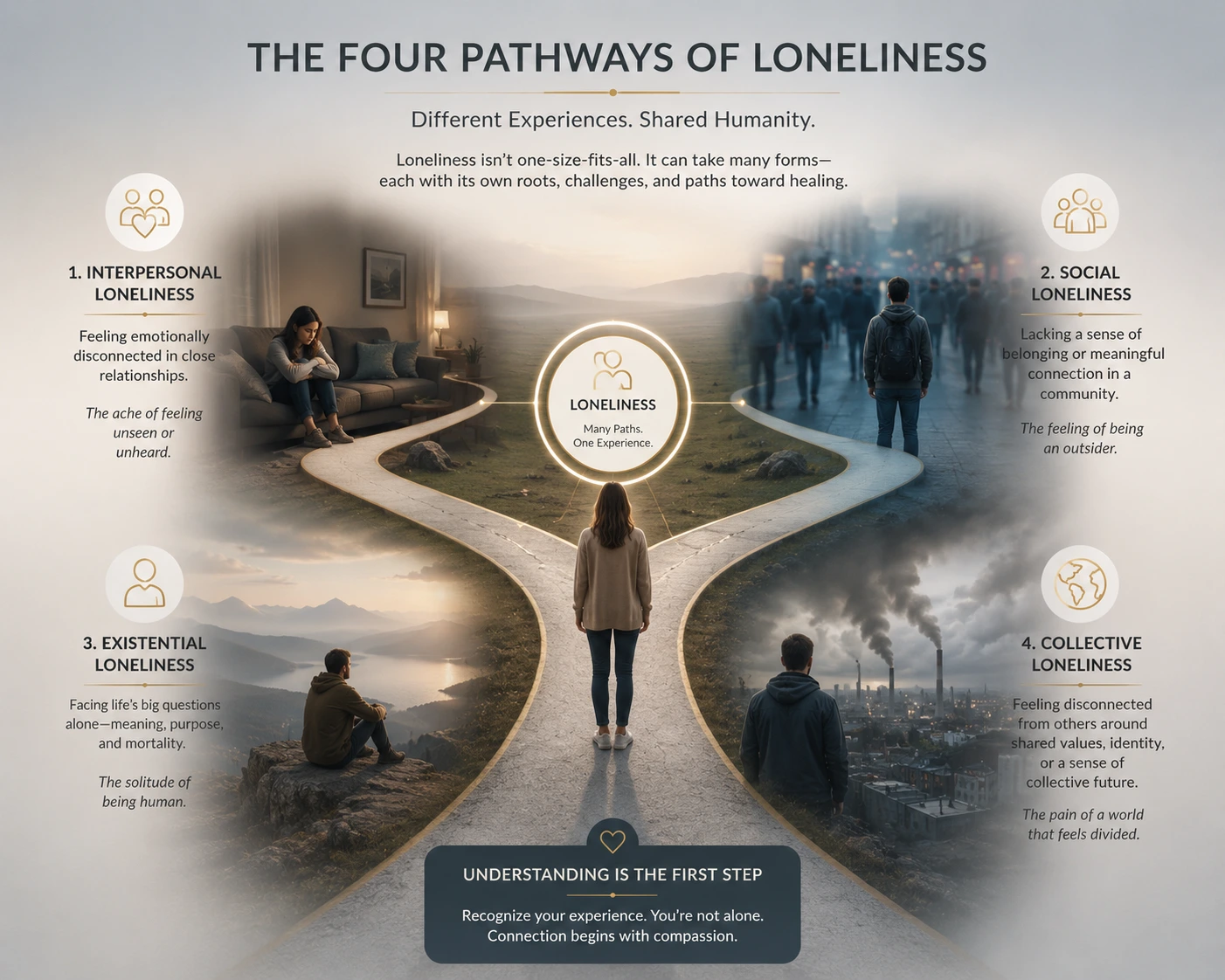
Not all loneliness is the same thing , and treating them the same way is part of why generic advice like "go socialise more" consistently misses. Understanding which type is active is what points toward what actually helps.
The absence of a close, intimate relationship , a partner, a best friend, someone who genuinely knows you. This is the most commonly discussed type. It's the loneliness of not having one person who you feel truly seen by , and it doesn't disappear by adding more people to the periphery.
The absence of a wider sense of belonging , a community, a group, a place where you fit. You might have one or two close relationships but still feel disconnected from any broader network. Common in people who've moved cities, changed careers, or grown out of old social contexts without building new ones.
The deepest form , a sense of fundamental aloneness in the human experience. A feeling that no matter how close you are to someone, there's an irreducible gap. This form isn't solved by social connection; it's more philosophical, and it tends to surface during significant life transitions, loss, or periods of forced self-examination.
The absence of connection to something larger , a shared purpose, a cause, a community united by something meaningful. Social connection at the collective level feeds a specific human need that one-to-one relationships don't replace.
Most people experiencing chronic loneliness are dealing with a mix of these , often interpersonal and social together. Naming which ones are active stops the framing of "I just need more friends" as the universal solution when the actual need is something more specific.
The psychology of loneliness becomes a mental health concern when it stops being temporary and becomes the baseline.
Chronic loneliness , sustained, unresolved emotional isolation over months or years , has measurable psychological effects:
Loneliness and mental health interact in a loop that's hard to break from the inside. The lonelier someone gets, the more threatening connection begins to feel. The more threatening it feels, the less they reach for it. The less they reach, the lonelier they get.
The psychology of loneliness isn't always obvious from the inside , especially because the people most affected are often the ones who appear most self-sufficient.
Signs worth paying attention to:
That last one is important. Long-standing emotional isolation starts to feel like who you are rather than a condition you're in. It isn't.

The advice to "put yourself out there" is not wrong , it's just incomplete. Social connection that addresses genuine loneliness requires more intention than proximity.
What actually moves things:
My Fit Brain works with people carrying exactly this , not a dramatic crisis, but the quiet, persistent weight of feeling genuinely unseen. That's what mental health counselling is actually built for. Understanding what's sustaining the emotional isolation and building the capacity to actually let people in.
The psychology of loneliness is not simple and it's not solved by adding social commitments to a calendar. It's about the quality of connection available versus what's actually needed , and the internal barriers that make the gap harder to close than it should be.
Being lonely in a full life is one of the more quietly painful human experiences. And one of the most common ones that goes unaddressed , because it doesn't look like a crisis from the outside, and because the people experiencing it are often the best at functioning through it.
You are allowed to name it. You are allowed to want more than managed emotional isolation. And you don't have to figure out how to bridge the gap alone.
If loneliness has become the quiet background of your life , a qualified therapist can help you understand what's sustaining it and what actually shifts it.
The Transformation , 10 sessions at ₹9,999. Same therapist throughout, 30 minutes each, from your phone. 100% confidential.
Yes , intensely and consistently. Borderline personality disorder involves deep emotional isolation rooted in fear of abandonment and unstable sense of self. Chronic loneliness is one of the most reported experiences in BPD, even in people with active relationships , because the fear of rejection makes genuine closeness feel simultaneously necessary and unbearably threatening. Mental health counselling specifically for BPD addresses this directly.
The psychology of loneliness is the study of how humans experience, process, and respond to the absence of meaningful social connection. It covers why loneliness activates the same neurological threat response as physical pain, how chronic loneliness distorts social perception over time, and what distinguishes temporary loneliness from the sustained emotional isolation that affects mental and physical health.
Yes , the relationship is bidirectional and well-documented. Loneliness and mental health interact in a loop: anxiety and depression make social connection feel riskier, which deepens isolation, which worsens anxiety and depression. Chronic loneliness also increases cortisol levels, disrupts sleep, and impairs immune function , making it a physical health concern alongside the psychological one.
Completely , and the psychology of loneliness explains why. The brain measures quality of connection, not quantity. Being surrounded by people who don't truly know you, or performing a version of yourself that isn't real, or being in a room full of people where no genuine contact is happening , all of these can produce the same emotional isolation as being physically alone.
Sustained chronic loneliness is associated with significantly elevated risk of anxiety and depression, cognitive decline, disrupted sleep, weakened immunity, and cardiovascular issues. Psychologically, it erodes self-worth, increases social threat-perception, and creates the avoidance cycle where connection feels increasingly risky the more it's needed. The Surgeon General's 2023 advisory placed its health impact on par with smoking 15 cigarettes daily.

Online
English, Punjabi, Haryanvi
Couple Counseling, Marital Counselling, LGBTQ, Addiction, Depression

You say yes when you mean no. You apologise for things that aren'...
 22 Jun 2026 8 min Read 36 Reads
Your phone is the last thing you look at before sleep and the first t...
20 Jun 2026 8 min Read 46 Reads 
Someone didn't text back on time. Your manager gave mildly critical fee...
19 Jun 2026 8 min Read 82 Reads 
You had the opportunity. You were ready. And then somehow, you weren't....
18 Jun 2026 8 min Read 77 Reads 
Area Of Expertise : Couple Counseling, Marital Counselling, LGBTQ, Addiction, Depression, Family Counseling, Relationship Counselling, Anger Management, Sexual Wellness, Marriage & Couple Counselling
Book a Session
Better mental health at your convince
